
Booking.com and Airbnb are brilliant at getting holiday properties in front of potential guests. They've got enormous audiences, established booking systems and the sort of marketing budgets most cottage owners can only dream about.
So why bother having your own website?
It's a fair question. After all, if your cottage is already getting bookings, why spend money on something else?
The answer isn't that you should abandon the big booking platforms. Far from it. Your own website gives you something they can't: a place where your property is the only one on show, you decide what visitors see and you can encourage guests to book directly.
And there's a lot more to it than saving a few quid on commission.
1. Your cottage gets the attention it deserves
Imagine somebody finds your lovely stone cottage on a booking platform. They've looked through the photographs, read the description and started picturing themselves sitting outside with a glass of wine.
Then, just below your listing, they spot another cottage. It's got a hot tub. And a bigger garden. And it's £20 cheaper.
Suddenly, they're looking at somebody else's property.
That's the nature of booking platforms. They're designed to help people compare accommodation, which is brilliant for guests but not always ideal for owners.
On your own website, there's no competing cottage waiting to steal the limelight.
You can give visitors a proper tour of your property, explain what makes it special and help them imagine staying there without constantly being encouraged to look elsewhere.
2. You can show off more than a handful of photographs
Booking platforms give you space for photographs and descriptions, but you're still working within their layout and rules.
Your own website gives you much more freedom.
Perhaps you've got a beautiful kitchen, a log burner, a secluded garden or views across the countryside. Maybe the cottage has an interesting history, or you've spent years restoring it.
These are the details that make a property memorable.
A good holiday cottage website can include:
- A proper photo gallery showing every room, the outside space and the surroundings.
- Clear information about facilities, from parking and Wi-Fi to dog-friendly arrangements.
- Floor plans, particularly useful for families and larger groups.
- Details about the owners, giving guests a sense of who's behind the property.
- Seasonal photographs, showing what the cottage and surrounding area look like throughout the year.
- Helpful answers to common questions, so guests know what to expect before booking.
You don't need to cram everything onto the homepage, either. Give each subject enough room and make the information easy to find.
And please, invest a little time in your photographs.
A beautifully furnished cottage photographed on a gloomy Tuesday with washing-up in the sink isn't going to look quite as appealing as it should.
3. Direct bookings could save you money
This is usually the bit that gets cottage owners interested.
Booking platforms provide a valuable service, but depending on the platform, agreement and booking arrangements, they may charge owners commission or other fees.
Let's use a simple example.
Suppose a guest books a week at your cottage for £700, and your booking platform charges you 15% commission.
Weekly booking value | £700 |
Illustrative platform commission (15%) | £105 |
Remaining before other costs | £595 |
That's £105 from a single booking.
Now imagine a returning guest visits your own website and books directly instead.
You may still have payment processing charges or booking software costs, but you could avoid that particular platform commission.
Five direct bookings at £700 each could mean £525 less in commission, using the same illustrative 15% rate.
Of course, commission rates vary, and direct bookings aren't completely free to process. But the potential savings are worth considering.
Does that mean you should stop using Airbnb or Booking.com?
Absolutely not.
They're excellent ways to reach new customers, particularly people who've never heard of your property.
A sensible approach is to use those platforms to attract guests while also building your own online presence.
Your website gives people another way to find you, learn more about your cottage and potentially book directly.
Just make sure you understand any relevant platform terms and keep availability synchronised if you're accepting bookings through several channels.
4. Returning guests can find you directly
Think about the last time you stayed somewhere you really liked.
If you wanted to return, would you necessarily go back through the same booking platform?
Probably not. You might search for the property's name on Google and see whether it has its own website.
That's where having a recognisable online presence becomes valuable.
A guest who's already stayed at your cottage knows what they're getting. They don't need convincing that the beds are comfortable or the kitchen has everything they need.
They just need to find you again.
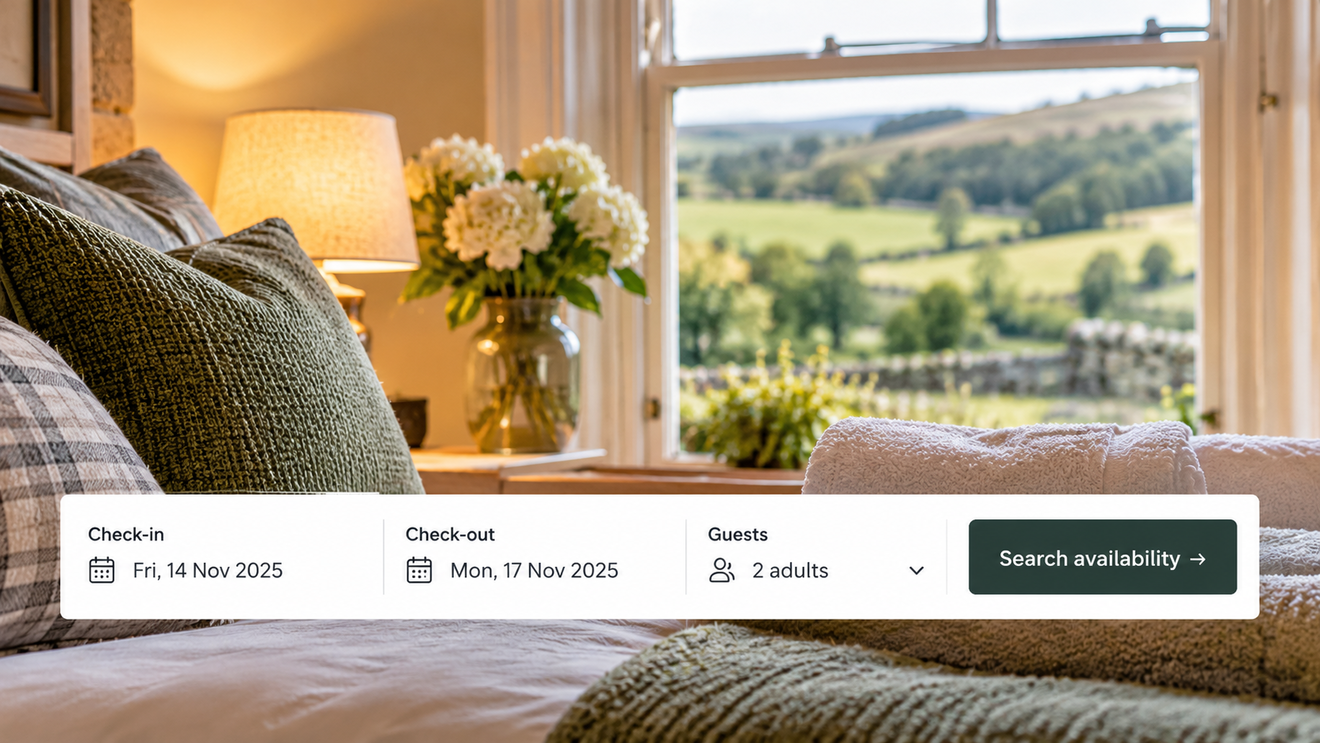
Your website can make that easy, with clear contact details, availability information and a straightforward way to enquire or book.
You can also include your website address in appropriate guest communications and printed information at the property, while respecting any booking platform rules.
And if guests recommend your cottage to friends or family, having a memorable website address gives them somewhere to send people.
5. Sell the location, not just the accommodation
Here's something that often gets overlooked.
People aren't simply booking a cottage. They're booking a holiday.
They want to know what's nearby, where they can eat, which beaches are worth visiting, whether there are good walks and what they can do if the weather turns miserable.
And let's face it, this is Britain. A rainy-day plan is rarely wasted.
Your website is a brilliant place to answer those questions.
What could you include?
- Local walks: Gentle riverside strolls, countryside routes and longer hikes.
- Places to visit: Castles, historic houses, gardens and family attractions.
- Food and drink: Local pubs, cafés and restaurants you genuinely recommend.
- Beaches and countryside: Great places for a day out, depending on your location.
- Practical information: Parking, public transport, supermarkets and other useful facilities.
This helps visitors picture the holiday they could have, rather than just the accommodation they'll sleep in.
It can also help your website appear in searches related to your area, particularly when the information is original, accurate and genuinely useful.
A little local knowledge goes a long way
At Nesmo, we also run Fabulous North and The Cheviots, two platforms dedicated to exploring places, walks and attractions across Northern England.
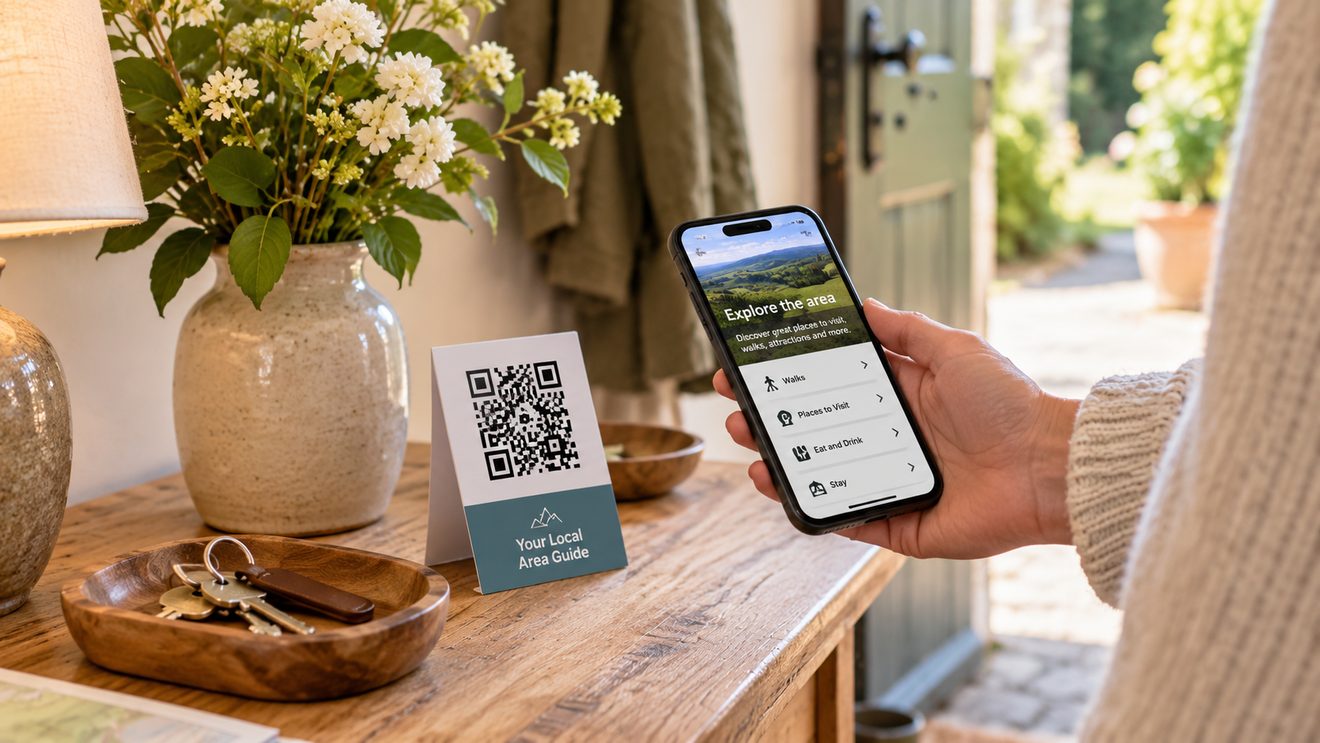
That experience has helped us develop Local Area Guides for accommodation providers, giving guests a selection of nearby places to discover.
The guides can be accessed through a simple QR code, and you don't need a Nesmo website to use one.
6. Your website can answer questions before guests ask them
How many times have you answered the same question about parking, dogs, check-in times or whether there's a travel cot?
A good website can do some of that work for you.
Consider including a dedicated section covering the questions guests ask most frequently.
For example:
- What time is check-in and check-out?
- Are dogs allowed, and are there any restrictions?
- Is parking available?
- Are towels and bed linen provided?
- Is there a cot or highchair?
- How far away are the nearest shops and pubs?
- Is the property suitable for guests with limited mobility?
The more useful information you provide, the easier it becomes for guests to decide whether your cottage suits their needs.
And fewer repetitive enquiries means more time for everything else involved in running a holiday property.
7. You can build a recognisable name for your cottage
A cottage called Rosebank Retreat might be listed on several booking platforms, but on each one it appears within somebody else's website.
Having your own domain, such as rosebankretreat.co.uk, gives your property a more recognisable identity.
You can use it on your social media profiles, business cards, welcome information and other promotional materials.
It also gives Google a dedicated website to associate with your property's name and location.
That doesn't mean you'll automatically appear at the top of search results. Search visibility takes time and depends on competition, content and plenty of other factors.
But having a well-structured website with useful information gives you a foundation to build on.
8. You don't have to become a website expert
Now, there's one obvious objection.
That all sounds lovely, but I've already got a cottage to run. I don't particularly fancy becoming a web designer as well.
Fair enough.
Between cleaning, maintenance, guest enquiries, laundry and the occasional mysterious disappearance of a teaspoon, holiday cottage owners have enough to keep them occupied.
The good news is that having your own website doesn't mean you need to build or maintain it yourself.
At Nesmo, we offer managed websites specifically for tourism and hospitality businesses.
We design and build your website, host it and look after the technical side. If you need to change some photographs, update information or make routine content changes, you can send them over and we'll take care of them.
Or, if you'd rather make changes yourself, you can do that too.
Our managed websites start from £49 + VAT per month, with no upfront development fee and a 12-month minimum agreement.
That means you can have your own website without adding another regular job to your list.
So, is having your own holiday cottage website worth it?
For many cottage owners, yes.
Not because Booking.com or Airbnb are bad. They're useful platforms that can bring in bookings you might otherwise never receive.
But relying entirely on them means your property is always presented within somebody else's system.
Your own website gives you more freedom to show off your accommodation, share helpful local information, establish a recognisable name and encourage direct bookings.
It also means returning guests have somewhere to find you without searching through hundreds of other properties.
You don't need to choose between booking platforms and your own website. They can work alongside each other.
And if your cottage is somewhere people genuinely love staying, it deserves a little corner of the internet all to itself.